Integration with LLM Tools
Large language models (LLMs) can be layered on top of a knowledge graph and structured metadata to enable more natural, scalable interaction with complex scientific landscapes.
By leveraging appropriate embedding models, each study is projected into a high-dimensional semantic space, enabling content-based similarity search across publications, methods, and research topics; this provides a foundation for identifying research overlaps, emerging themes, potential collaborators, and competitive activity.
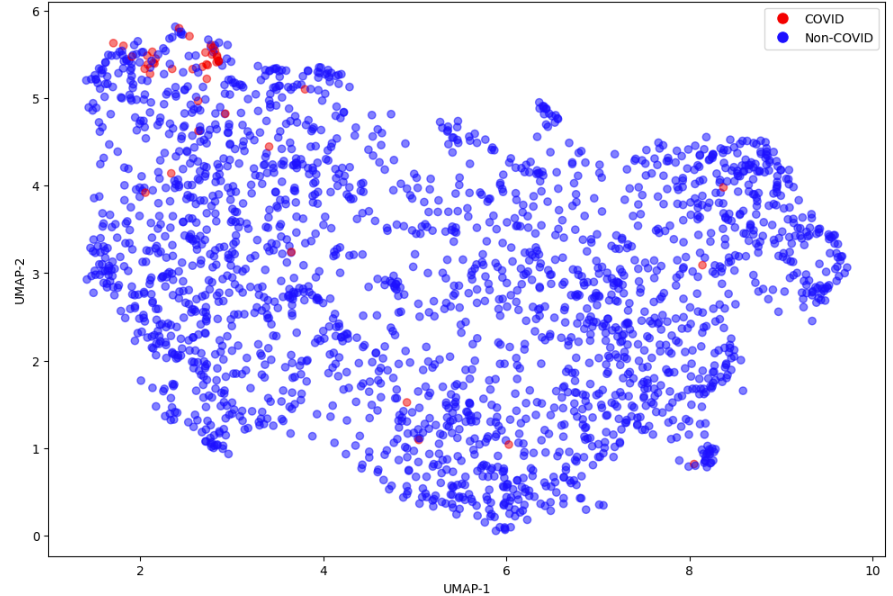
The UMAP projection above illustrates how scRNA-seq studies cluster by topic and methodological similarity, demonstrating how embedding-based representations can surface structure in otherwise unstructured literature.
Automated Scientific Messaging & Summarisation
Using prompt engineering in combination with structured graph context, LLMs can generate domain-aware, technically grounded text for repetitive tasks such as outreach, summarisation, or internal briefing.
Below is a deliberately simple zero-shot example illustrating how scientific context can be injected into automated messaging:
Subject: Enhancing Your Research on Intestinal Treg Functions
Dear Dr. Researcher,
I recently had the opportunity to review your work on immune microniches shaping intestinal Treg function. Your use of in vivo live imaging, combined with photo-activation-guided single-cell RNA sequencing and spatial transcriptomics, provides a compelling framework for understanding cellular interactions within the intestinal lamina propria.
At Genomics, we focus on advanced sequencing workflows and bioinformatics solutions. We would welcome the opportunity to explore how these capabilities could support or extend your research.
Best regards,
John Polymerase Genomics
While this example is intentionally minimal and illustrative, it demonstrates how LLMs can transform structured scientific context into usable, task-oriented outputs, reducing manual effort while preserving technical specificity.
Data-Driven Insights for Research and Innovation
By combining structured metadata, graph relationships, semantic similarity, and LLMs, this system enables a range of higher-level analytical and strategic use cases:
- Researcher & Method Mapping – Identify experts working with specific sequencing techniques, grouped by topic, institution, or geography.
- Study Discovery & Classification – Retrieve and cluster studies using methodological, biological, or disease-oriented criteria.
- Trend & Network Analysis – Track how technologies and research themes evolve across journals, regions, and time.
- Strategic Intelligence – Support technology scouting, partnership identification, and portfolio positioning through structured, explainable insight extraction.